The most exciting time of the year, the baseball playoffs, has arrived.
The team that has been an annual attendee at that party since 2017 – and nine times between 2015 and 2024 – didn’t earn an invitation this year.
Most of you, even if you’re not baseball fans, know who that team is, and you also know it’s my team. The one I’ve cherished and cheered for – win, lose (or yes, cheat, in 2017) – since I was a young boy in the mid- to late-1960s, living about 5 miles from the Astrodome in Houston.
And as most of you also know, it’s been tradition for me to write about my beloved Astros when the grueling 162-game regular season finally reaches its end and the playoffs begin. Their seemingly unending run of eight consecutive trips to the postseason – including two World Series titles, seven division crowns, and seven straight appearances in the American League Championship Series – brought me and so many other fans rapturous joy year after glorious year.
But now that the Astros are not playing October baseball for the first time since 2016, I realize I still need to write about them. Whether they make the playoffs or not, I have to put it all out there. I can’t just be a fan who boasts about his team when everything’s golden.
Terribly cliché as it is, all wonderful things truly must come to an end. That sad fact – although it makes the legions of baseball fans who hate the Astros giddier than a pup with the zoomies – ends the fourth-longest stretch of playoff contention in MLB history.
ONE MEASLY GAME
As someone who has faithfully followed the Astros for nearly 60 of my 64 years – listening by radio, reading game stories/box scores in newspapers/online, occasionally watching on TV, monitoring online through MLB GameDay, seeing them in person a handful of times each year – I’m going to call this one of their most unusual and frustrating seasons I can remember. We don’t have the resources ($$$) to watch them on DirecTV, Fubo or any of the other available services, so the last couple of years Kay and I have listened to most of their games on SiriusXM radio.
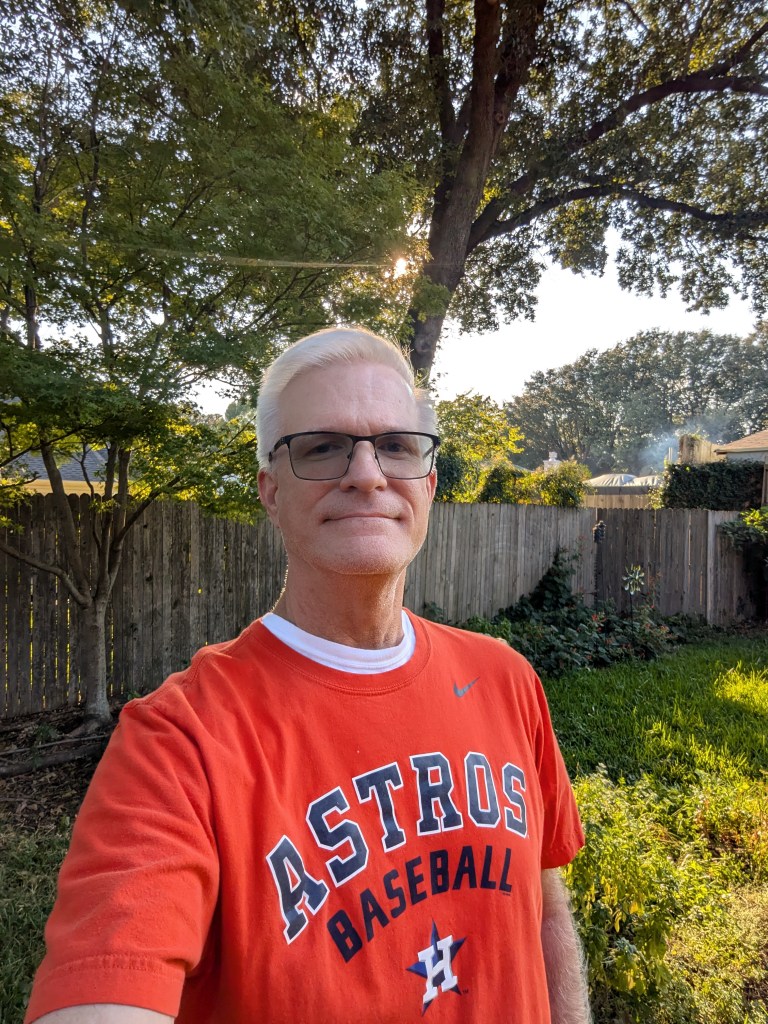
The Astros finished 87-75, in second place in the mediocre AL West, three games behind the Seattle Mariners, who swept a late three-game series in Houston that crushed the Astros’ division hopes. They still had a shot at one of the wild-card slots, but that sweep started a decisive week of six losses in seven games that made it nearly impossible to keep their playoff streak intact.
I keep telling people this, but I find it astounding that in pro sports’ most physically, mentally and emotionally torturous season, multiple marathons over an ungodly long six months, a team’s advance-or-stay-home fate can be decided by a single game. But in the Astros’ case, that’s just what happened: They tied for the final wild-card berth with the Detroit Tigers, who also knocked the Astros out of the playoffs in the opening round in 2024 and are led by former Astros manager A.J. Hinch. Detroit earned its playoff matchup against division rival Cleveland thanks to having swept the Astros in a regular-season series in August.
Throughout every season, there are numerous games that leave teams’ fans saying, “Aw, man, we should’ve won that game!” Early, mid-game and late leads that got away, blown ninth-inning saves, extra-inning losses. The Astros had a bunch of those this year that we can point to and say, “If only we’d won ONE of those 75 losses in 162 games, we’d be in the playoffs.”
But losses are losses. Can’t get ’em back.
I know a team can’t keep winning and going to the playoffs every year. Fans of the Astros have been spoiled by their remarkable annual rerun of excellence, even when many of the players most important to that success have moved on. And while I’m disappointed they’re not in the playoffs, I don’t believe for a microsecond that the window/door has slammed shut on the Astros being contenders in the next few years.
WHAT KEPT THEM OUT?
So why aren’t the Astros among the 12 teams (out of 30 in MLB) that advanced to the postseason in 2025? Most people assessing their season would say it’s because of all the injuries. And while that’s definitely the main reason, it’s not the only one (I’ll get to the others later).
An unbelievable 28 Astros hit the injury list, including eight with multiple stints. FanGraphs projected in September that Houston had lost a potential 17.6 WAR to injuries this year, most in the majors. (That metric, Wins Above Replacement, measures players’ value through the number of wins they provide to their team).
At one point, the Astros had 18 guys on the IL, including three members of their season-starting rotation (and two others, Cristian Javier and Luis Garcia, were already out after earlier Tommy John elbow surgery). Ronel Blanco and Hayden Wesneski had TJ surgery – Blanco after nine starts, Wesneski after six.
But even before those two were sidelined, fellow rotation mate Spencer Arrighetti – who’d made only two starts – sustained a broken right thumb April 8 after being hit by a batted ball during pregame workouts. He returned to the Astros in early August, made five starts, then went back on the IL a month later with elbow inflammation.
Garcia, a major cog in the Astros’ 2022 World Series season with a 15-8 record, returned strong Sept. 1 from his TJ surgery two years ago. But in chorus with how the whole season went, Garcia was injured in his second start and will miss all of next year. I feel terrible for him.
Plenty of Astros relief pitchers also landed on the injured list, including closer Josh Hader, who missed the last two months after a great year. But thankfully, several no-name pitchers came through to fill in the rotation and bullpen gaps, carrying the team most of the season when its offense struggled because of injuries – along with flailing plate approaches that made many opposing pitchers look like reincarnations of Cy Young.
Several position players critical to the team’s offense missed significant time, led by power-hitting DH/left fielder Yordan Alvarez. He was sidelined 100 games with a broken bone in his right hand before finally returning in late August to give the inconsistent offense a lift, but then missed the final 11 games after severely spraining his left ankle during the Astros’ sweep of the Texas Rangers – just before the critical series against Seattle.
Third baseman Isaac Paredes, acquired in the offseason from the Cubs when the Astros traded right fielder Kyle Tucker, was leading the team in home runs when he was lost for two months with a hamstring injury. He came back at less than full strength for the final two series, but by then it was too late to make a difference. Shortstop Jeremy Peña, who had his best season at the plate, missed critical late stretches with a broken rib and an oblique muscle strain.
Between Alvarez, Paredes and Pena, there’s no telling how much offensive production the Astros lost to just those three injuries. And I haven’t even mentioned center fielder Jake Meyers, who was having his best offensive season when he went out with a calf injury, missing two months. He came back late too, but it was clear his bat wasn’t where it had been earlier.
While the season-long torrent of injuries played the biggest role in the Astros falling short of the playoffs, other issues need to be addressed before spring training. Concerning the injuries, the team’s medical staff/trainers need a serious overhaul. There must be underlying problems in how players’ physical regimens are being managed, both when healthy and when hurt. For so many players to be injured in one season, and for several to be hurt multiple times, something isn’t right and changes must be made. Whether they’re bringing injured players back too soon or their rehab approach needs adjusting, they’ve got to figure it out before next season.
FIXING THE PLATE APPROACH
Last but far from least, the matter I mentioned about the Astros’ plate discipline is huge. I get to watch very few games, so much of my take on this is based on listening to the Astros’ radio team of Robert Ford and Steve Sparks, fellow Astros fans (including my Astros text chat of seven dear friends, several of whom DO get to watch the games), and what I read online.
The hitters’ overall approach, especially with runners on base to be driven home, often plays right into pitchers’ hands: They swing at bad pitches (pitchers’ pitches), they don’t swing at hittable pitches, they swing too hard, they often don’t “hit the ball where it’s pitched,” they don’t work the count – and in general, they just aren’t patient.
My Astros chat buddies and I, who text during EVERY game, have lamented all season that the Astros need new hitting coaches. We said this last year too. In a period when offense has been down across MLB, they hit .250 as a team (Toronto led the majors at .265). Houston ended the season with the second-highest chase rate in the majors (swinging at pitches outside the strike zone), after only the Rockies, one of the worst teams in baseball history, finishing with a 43-119 record. The Astros also had the third-highest swing rate.
With runners in scoring position – the all-important RISP category – the Astros’ batting average was .245, ranked 23rd in baseball (again, Toronto led at .292). I’m actually surprised the Astros’ RISP average was that high. A year ago, when the Astros hit .262 as a team (third in baseball), their RISP average was .267 – sixth in MLB (again, a bit surprised).
And listen, I played ball growing up and know how hard it is to hit a baseball. Obviously I’ve never tried to hit a 98-mph fastball, an 88-mph slider, a cutter, a sinker or a changeup. But still, the Astros have great hitters who just need some coaching up on taking a consistent mindset to the plate for every at-bat. That should be a given, and drilling that into their game routine will make them a much more productive offense. But it’s a tough as hell game and there are numerous factors to consider.
NEXT YEAR WILL BE DIFFERENT
Despite all this, the Astros missed the playoffs by a single game. What does that say about this team and franchise? It says they’re resilient, have a great makeup and chemistry, and they’ve all taken on the team’s winning mantle and are determined not to let it go.
It also demonstrates the parity of today’s MLB, where no team won 100 games (the Brewers’ 97 was the highest total). Does it say the Astros play in a weak division? Maybe. But considering they won 87 games and Toronto, at 94, won the most in the AL, that’s not much of a gap.
To me, it also says they’re much better than what their final record and missing the playoffs show, and that next year should be much better. There are some “ifs” too – if they get some of these guys healthy and they can stay healthy. If they come up with a better, teamwide strategy at the plate. If they can sign a starting pitcher and another solid left-handed bat.
Of course, every team will have its share of injuries over such a crazy-long season. I’ve read that what the Astros endured this year was a record number of injuries. Surely history won’t repeat itself. Let’s hope.
As I close this long-winded (apologies!) epitaph to the Astros’ playoff-less season, let me also say that it’s the first year I can recall them not winning any of their games I attended. That totaled four – two when they played the Rangers here in Arlington, one in Houston vs. the Orioles in August, and one vs. the Red Sox in Boston when Kay and I traveled there earlier that month. Just as I’m counting on the Astros to get back where they belong next year, I’m planning to get back to my winning ways when I see them in person.
Get healthy, Astros. Get new hitting coaches and medical staff/trainers. Get your minds right and ready for 2026. You’ll be back. I’m sure of it.
GO ASTROS!!!
 A Life of Words